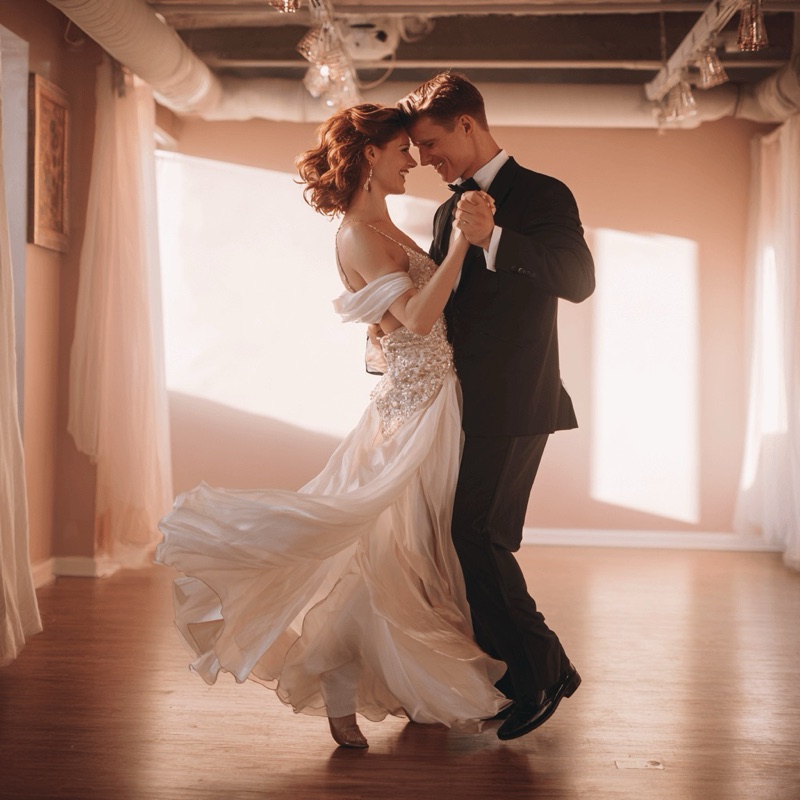
Our reception is in an oast house outside Canterbury with a beam across the dance floor. Does that limit things?
It rules out anything vertical under that beam and almost nothing else. Give your instructor the rough height and where the beam sits and the routine is built around it, usually by keeping the travelling section to one side of the room. Old Kent buildings are full of these details, which is exactly why we like seeing the room first.
We are on a temporary floor under a marquee outside Canterbury. Can you plan for that?
Yes, with a small caution about spins. Panelled floors laid over grass have joins that catch a heel and give very slightly underfoot, so we favour steps that keep weight settled rather than pivoting sharply. If you can get onto it the day before, one run-through there is worth several at home.
The venue near Whitstable can only let us in on a weekday morning. Does a run-through at that hour earn its keep?
Very much so, even in daylight with the chairs stacked. What you are checking is the size and the surface, not the atmosphere. Pace out where the routine begins and ends, feel how the floor grips, and note where the band or the DJ will be. An empty room in the morning still answers the questions that matter.
Does a short first dance really need lessons at all?
Need is a strong word. Plenty of couples sway for thirty seconds and are perfectly happy. What one or two lessons buy is the difference between swaying and looking like you meant to sway, which mostly comes down to hold, weight and knowing how you are going to stop. If that does not bother you, do not book anything.
How much of the routine can be decided before we have seen the room?
Most of it, honestly. Hold, timing, the opening and the ending all travel anywhere. What waits for the room is the scale: how far the middle section travels and whether the turns get their full circle. That is why the venue session, where it is possible, usually lands late rather than early.
Canterbury function rooms are often smaller than couples expect. Can a routine survive that?
It can, provided somebody adjusts it rather than hoping. A dance built for twelve square metres and performed in six looks cramped and rushed. Tell your instructor the real measurement, even roughly, and the choreography is drawn to fit from the start. Shrinking a routine afterwards is always the worse of the two jobs.
We want to sway and nothing more. Will an instructor be disappointed?
No, and anybody who was would not be teaching for us. A well-held, unhurried sway with a proper ending is a good first dance, and it is genuinely easier to deliver under pressure than something elaborate. The single lesson exists precisely for couples who want that and nothing further.
Send us a question